
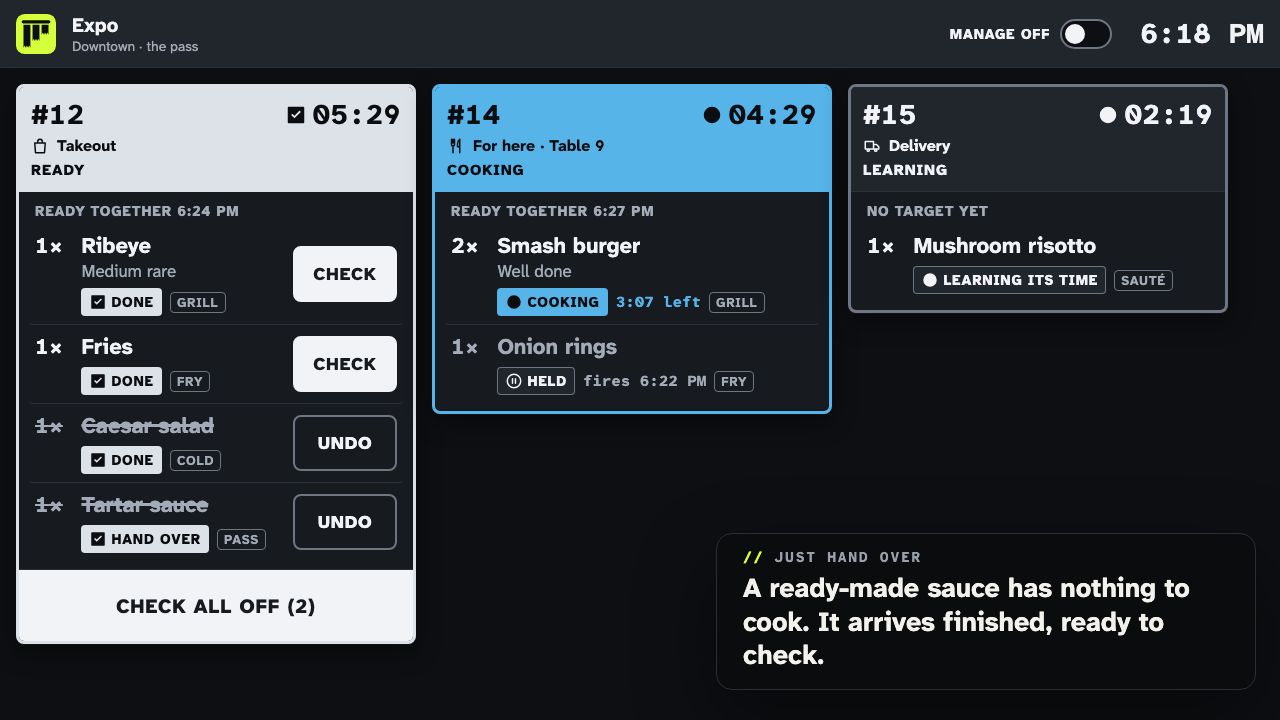
Every kitchen has a moment where the food leaves the cooks’ hands and goes to the guest. The person standing there is the expo.
What the expo does
- Checks the plate. Right dish, right doneness, right modifiers, nothing missing: the allergy note, the sauce on the side.
- Brings the order together. A table of four should get four plates at once. The expo holds what is ready and chases what is not.
- Calls the line. “Two ribeye, one medium rare, all day.” “Where are my fries on 12?” The expo keeps stations talking to each other.
- Sends it out. Hands the finished order to a runner or server, and marks it done.
On a busy night that is a lot of timing work held in one person’s head.
The timing problem at the pass
Most of an expo’s stress is not checking plates; it is waiting. When every station starts a ticket at once, the salad is ready in 3 minutes and the steak in 12, so the expo spends 9 minutes holding a salad and shouting for the steak. Multiply that by every ticket on the rail.
What an expo screen does
On a kitchen display system (KDS), the expo screen shows every order and the state of each item at each station. A good one lets the expo:
- See which items are cooking, done or still waiting.
- Check items off as they are plated, and undo a mistake.
- See when the whole order is expected to be ready.
- Recall an order that was cleared too early.
How PrepFlow changes the expo’s job
PrepFlow paces each item to start at its own minute, so items reach the pass together and the expo checks, plates and sends instead of holding food. The expo screen checks items off with CHECK and UNDO, can check a whole order off at once, and shows when each order is projected to be ready.
The expo screen has a Manage switch. Off, the expo only checks items off. On, the expo can also start and finish items for the stations and sees the FIRE NOW and START NOW alerts, for kitchens where the expo runs the line. A dish plated at its own station can be set to Skip Expo, so that station checks it off and the expo is not slowed by it.
Read more about why orders come out in pieces.
Questions
Is it expeditor or expediter?
Both spellings are used in kitchens. Expeditor is common in restaurant job titles; expediter is the standard dictionary spelling. Most kitchens just say expo.
Does every kitchen need an expo?
Not always. Small kitchens often have the last cook plate and send. A dish that is plated at its station can skip the expo entirely, as long as someone is responsible for checking it is complete.